
During pregnancy and after giving birth, your body goes through many changes.
That’s why it’s important to take your measurements to choose the size that suits you best.
How to take your measurements
All you need is a measuring tape (also called a tailor’s tape).

Bust measurement
Place the tape around the fullest part of your bust (right over the nipples), and try to keep it perfectly horizontal all the way around. If the tape dips in the back, it can add unnecessary centimeters. Don’t hesitate to ask someone for help!
Good to know: For best accuracy, it’s better to measure before feeding, when your breasts are at their fullest. This will help avoid tight-fitting tops when your breasts are full.
Try to avoid measuring during a milk surge: breast volume is much larger than usual, and you might end up picking one or two sizes above your actual fit.
If you haven’t given birth yet, no worries — you can already choose your size! Your bust at the end of pregnancy is usually very similar to what it will be during breastfeeding.
Hip measurement
Place the tape around the widest part of your lower body. Again, make sure it’s completely horizontal for an accurate reading.
Don’t pull it tight or leave extra room — the tape should be snug but not squeezing or sagging.
Compare your measurements with the chart below to find your perfect size.
| Size | Bust | Hip | ||
|---|---|---|---|---|
| cm | in | cm | in | |
| 34 | 84 | 331/8 | 86 | 337/8 |
| 36 | 88 | 345/8 | 90 | 353/8 |
| 38 | 92 | 361/4 | 94 | 37 |
| 40 | 96 | 373/4 | 98 | 385/8 |
| 42 | 100 | 393/8 | 102 | 401/8 |
| 44 | 104 | 407/8 | 106 | 413/4 |
| 46 | 108 | 421/2 | 112 | 441/8 |
| 48 | 112 | 441/8 | 117 | 46 |
| 50 | 116 | 455/8 | 122 | 48 |
| 52 | 120 | 471/4 | 127 | 50 |
| 54 | 124 | 487/8 | 132 | 52 |
What if my measurements fall between two sizes?
If you're sewing a top (like a t-shirt or sweatshirt), simply go with the size that matches your bust measurement.
If you’re planning to make a dress, there are two scenarios:
Case #1: Your hip size is larger than your bust size
If you like flowy dresses, just go with the larger size. It’ll be looser at the bust but fit comfortably over the hips.
Prefer a more fitted look? Then you’ll need to tweak the pattern slightly to achieve the silhouette you want.
No worries — it’s easier than you might think!
Every body is different, and it’s rare to find a pattern that fits perfectly without adjustments.
Think of the pattern as a great starting point to create a garment that truly fits you.
Here’s a simple step-by-step guide:
- Print your pattern selecting both sizes that match your measurements;

- Identify the pattern pieces that will cover your hips once the dress is finished;
- Figure out where the top of the skirt hits on your body.
For example, the skirt on the Sophie nursing dress starts around mid-bust (nursing opening),
while on the maxi dress it starts just under the bust; - From that point, measure the distance on your body to the waist and hips;
- On the front skirt piece, mark these points on the pattern and draw horizontal waist and hip lines;
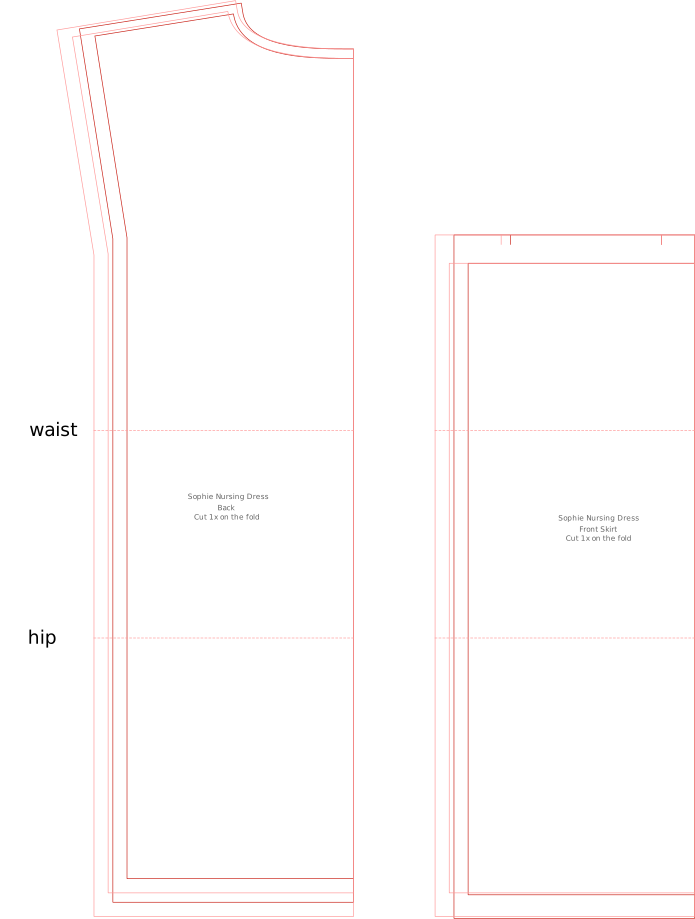
- From the skirt size that matches your hips, draw a gentle curve to the smaller bust-size skirt piece, meeting at the waist.
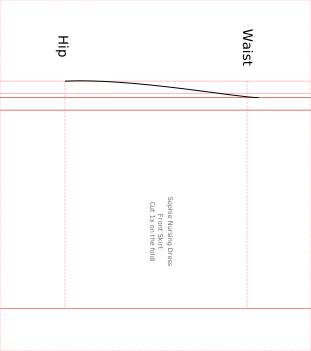 Repeat the curve on the back piece.
Case #2: Your hip size is smaller than your bust size
In this case, simply go with the size that matches your bust.
The dress will be a bit more relaxed at the hips but still keep the original shape.